

A van seller’s day on a phone: load, round, invoices, close
From morning load to evening close, what a van seller does with van sales software on a phone at each step, and what the office sees, even with no signal.
A van seller loads in the morning, visits the shops on the round, sells, delivers, collects and comes back in the evening to count. That day has the same shape at every distributor. How much of it is written on paper and typed again at night varies from one distributor to another. This article follows one day on a phone, step by step, in sahmrev Distribution, our van sales software. Distribution is an early version: it works today, but it is not open to new clients yet.
The day starts at the ramp. The office has planned the week from the routes, so the round already lists its shops in order. When the driver asks to load, the phone proposes yesterday’s load as a starting point. The driver and the person at the warehouse count it together and post it as a transfer from the warehouse to the van. A load above the van’s limit is refused, so an overloaded van is caught at the ramp, before it leaves.
Then the driver presses "Start my round" and opens the first stop. Before a word is said, the phone shows what matters about that shop: its balance, the credit it has left, what it bought last time, the products to offer today and any order waiting to be delivered. The products to offer come from the must-sell list the office has set, and the driver ticks "Offered" for each one. Later the office sees what was proposed next to what was sold.
Selling and giving credit at the stop
Selling is a search and a quantity. Promotions apply by themselves, and a driver’s discount cannot go beyond the limit the office has set. In the payment step the customer pays in cash, by cheque, by card, by transfer or by mobile money, or leaves the rest on credit. The customer signs on the screen, and the driver records the sale. The receipt prints on a small Bluetooth printer in the van, 58 or 80 mm wide, or goes to the customer by message.
Most van sales go wrong on credit. A shop that owes too much asks for one more delivery, and the driver, who wants to sell, agrees. Here, a sale over the shop’s credit limit stops on the phone until a manager types their own code. The code works even without signal. It is checked again when the phone is back online, and after three wrong codes it locks. The manager stays in control without having to be in the van.
At a stop the driver can also deliver an order an order taker wrote last week, take an order for another day, collect money against open invoices, or take back goods with a reason and a photo: damaged, expired, unsold, wrong product. Crates and bottles given and taken back are counted in the payment step, so the empties each shop holds are known at any time. If a shop is closed, "Skip this stop" keeps the reason. A new shop found on the road is added with its name, its phone, a photo and the position where the driver stands.
Offline on the road, visible at the office
All of this happens on a phone that loses signal in a basement, a market or a village. The round is kept on the phone, so nothing waits for the network. Each sale, payment and return is saved on the phone, and a banner shows what is waiting. When the signal comes back, the items leave in the order they were made. A sale that is sent twice counts once. If the office refuses something, the phone says why, and the driver sends it again or gives it up. Every document keeps the time and the place where it was made.
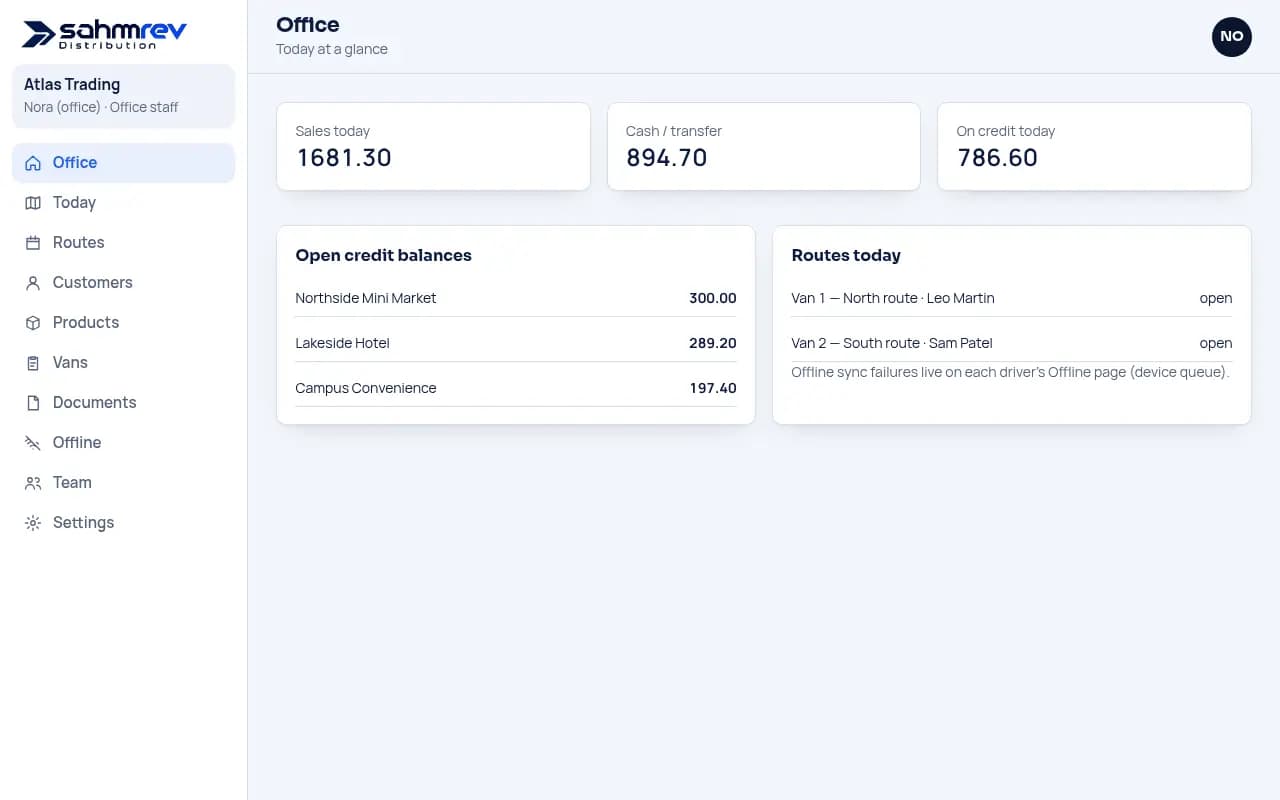
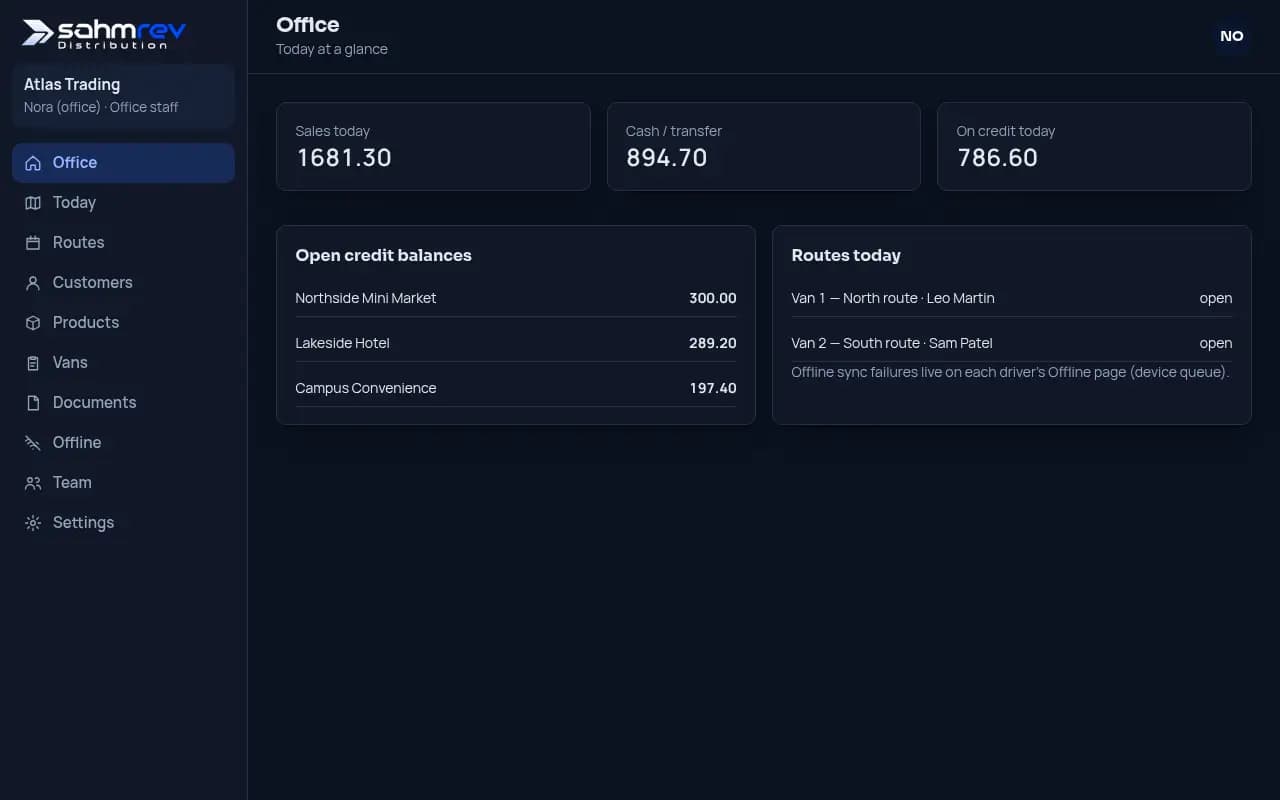
While the round goes on, the office watches the same day from its own screen. It sees each round’s progress, the next shop, what was skipped and why, and whether each visit took place at the shop itself, within 150 metres of its position. The map shows the same day as points on a road. Nobody has to call the driver to ask where they are or what they have sold.
The day closes with a count
In the evening the driver and the office close the day together. The phone starts the close only when nothing is waiting to be sent. The driver counts the van stock product by product, gives a reason for each difference and ticks what stays on the van for tomorrow. Next comes the cash. Notes and coins are counted, and the phone shows the cash expected from the day’s cash sales and collections, and the difference. Cheques and transfer references are listed. Both people sign with their names, and the day is closed.
Closing the day posts what was counted: the stock differences, the goods unloaded back to the warehouse and the cash handed to the company’s cash box. The day summary and the deposit slip come out as PDFs. The office confirms the close, and if something was wrong, a manager can reopen the day with a reason that is kept. Nothing from the round is changed afterwards. Corrections are new documents.
sahmrev Distribution is built for this day. It includes everything in sahmrev Commerce and adds van sales: vans with their own stock and cash, routes, rounds, the driver’s phone and the day close. It is an early version, not open to new clients yet, so the Distribution page invites you to tell us about your rounds. The food wholesale page shows how lots and expiry dates follow the goods, which matters as soon as a van carries food.
Common questions
- Does it work without signal?
- Yes. The round is kept on the phone, and sales, payments and returns wait there until the signal comes back. They leave in order, and a sale sent twice counts once.
- Which printer does a van need?
- A Bluetooth receipt printer, 58 or 80 mm wide, used from Chrome on an Android phone. The receipt can also be sent by message.
- Can a driver sell over a shop’s credit limit?
- Only with a manager’s code typed on the phone. Without signal the code is checked again later, and three wrong codes lock it.
- Can my company start using Distribution now?
- Distribution is an early version. It works today, but it is not open to new clients yet. Tell us about your rounds and we will come back to you.