

Why your quote takes three days, and how to send it the same hour
Fast quote software for workshops turns a customer’s size into parts, a price and a cut list, so a made-to-measure quote leaves the same hour.
A customer calls on Monday for a marble worktop, two windows or a run of kitchen cabinets, and the quote leaves on Thursday. Nobody in the workshop was idle. The quote waited for a price one person knows, for parts computed by hand, and for a cut list that says how much material the job takes. Fast quote software for workshops removes those three waits.
The first wait is the price. In many made-to-measure workshops the price of a square metre of marble, a metre of profile or a sheet of MDF lives in the owner’s head, or in a spreadsheet last updated at the supplier’s last increase. When the owner is on a site, the quote waits. When the sheet is old, the quote is wrong.
The second wait is the arithmetic. A worktop is an area, metres of polished edge, cut-outs and installation. A window is frame and sash lengths with deductions that depend on the profile system, panes, handles and hours of assembly. A cabinet is sides, a top, a bottom and shelves, with the board’s thickness taken off and the edge banding counted in metres. By hand, each takes a calculator, a sketch and some quiet.
The third wait is the material. To know how many slabs, bars or panels a job will use, someone has to place the parts on them: that is the cut list. In many workshops it is made after the order, at the saw, so the office either waits for it or prices with a guess and hopes the offcuts cover the difference.
A price list that stays current
The same hour starts with a price list of your materials. In sahmrev Workshop each material is a product with its unit: slabs, panels and glass by the square metre, profiles by the metre in their 6 m bars, edge banding by the metre, labour by the hour. Metal sold by weight carries a price per kilo on its material, and the parts made of it follow the price of the day. Purchases keep costs current, since each receipt moves the product’s average cost.
The material also carries what the workshop knows about it: whether parts may be turned on it (white marble keeps its vein, MDF has none), its saw kerf, the smallest offcut worth keeping and its usual loss, 10 % for white marble, 8 % for MDF and 5 % for aluminium profiles in the ready-made trades. These are written once, and every quote and cutting plan reads them. A quote already sent keeps its price when a material changes, because each priced configuration is kept as it was.
Each product gets its own template
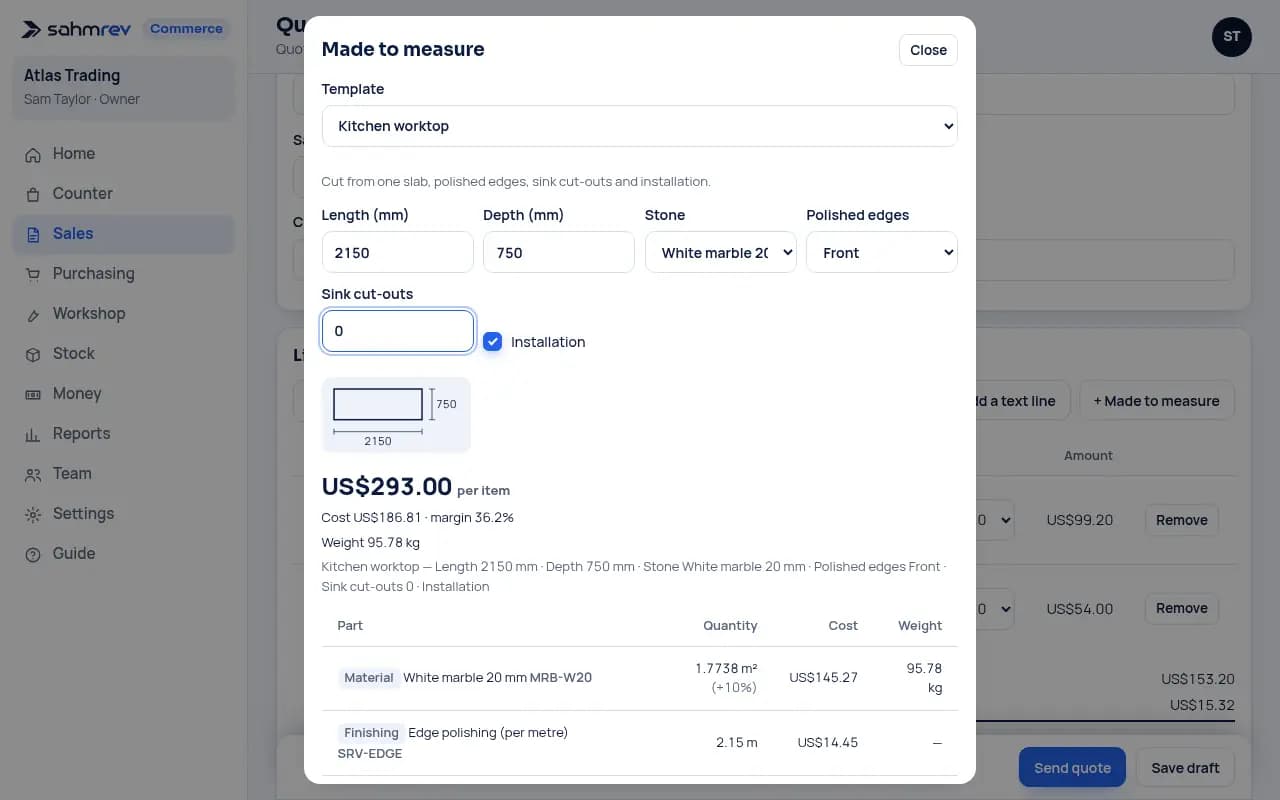
The second piece is the template. A made-to-measure template says what the seller types (sizes, choices such as the stone or the colour, yes or no for installation), the rules that turn those into parts, and how the price is made: the cost of the parts plus a margin, an optional minimum and a rounding step. Each Workshop trade starts with ready-made templates that you adjust to your own deductions and margins, and you can write new ones. The price updates on the screen while the seller types.
Take a worktop of 2150 × 750 mm in white marble 20 mm, front edge polished, no sink cut-out, with installation. The template gives 1.6125 m² of stone, 1.7738 m² with the usual 10 % loss, and a weight of 95.78 kg for the delivery. It adds 2.15 m of edge polishing and 1.6125 m² of installation, and puts one part of 2150 × 750 mm on the cut list. Polish both ends as well and the edge grows by twice the depth, to 3.65 m.
An aluminium window of 1200 × 1200 mm with two sashes, the template’s own example, gives four frame lengths of 1200 mm, four sash rails of 560 mm, four sash stiles of 1160 mm, two panes of 470 × 1070 mm, two handles and 2.5 hours of assembly. With the 5 % loss, that is 5.04 m of frame profile and 7.22 m of sash profile. Choose a RAL colour instead of white and a lacquering line is added for the 12 m of frame and sash.
A kitchen base cabinet of 600 × 720 × 560 mm in 18 mm MDF with one shelf gives two sides of 720 × 560 mm, a top and a bottom of 564 × 560 mm once the sides' thickness is taken off the width, and a shelf of 564 × 540 mm. That is 1.7426 m² of MDF, 1.8821 m² with the 8 % loss, plus 3.13 m of edge banding, one line for hinges and feet and one hour of panel cutting.
The quote fills the cut list
Because every material line of a template also puts its parts on the cut list, the quote no longer waits for the saw. The material is priced with its usual loss, and the cutting is planned once the order is confirmed: in Workshop › Cutting you tick the orders that need a material and plan them together, offcuts in stock first, with the kerf between the parts. For the window above, the four frame lengths take 4816 mm of a 6 m bar, and the 1184 mm left go back to stock as a numbered piece.
A quote in the hour rests on work done once: the materials and their prices, and a template for each product you sell. After that, the seller types the sizes, checks the price and sends the quote as a PDF or as a link the customer can accept online. sahmrev Workshop includes everything in sahmrev Commerce and adds the workshop work. The live demo’s workshop is a stone workshop, with numbered marble and granite slabs, the worktop and stair tread templates, and a hotel’s job from quote to cutting plan. The demo has no aluminium or wood workshop. The aluminium joinery and wood joinery pages show those templates and their numbers.
Common questions
- Do I have to write the templates myself?
- No. Each Workshop trade starts with ready-made templates: a kitchen worktop and a stair tread for stone, a window and a fixed frame for aluminium, a base cabinet and an oak table top for wood. You change their deductions, margins and prices to yours, or write new ones.
- What happens to a quote already sent when a material price changes?
- It keeps its price. Each priced configuration is kept as it was, and changing it makes a new one. New quotes read the new price.
- Can metal be priced by weight?
- Yes. Put a price per kilo on the material, and the parts sold by weight cost that price of the day. Every configuration also gives its weight.
- Can I try it on my own trade in the demo?
- The live demo has a stone workshop with slabs, the worktop and stair tread templates and a hotel’s job. It has no aluminium or wood workshop; their trade pages show those templates and their numbers.