

Marble slabs measured in millimetres, offcuts used first
A marble slab cutting plan that counts the saw cut can fit ten stair treads on one slab and keep the offcut with its own label.
The slab is the most expensive thing in a stone workshop’s yard, and it is never quite the size on the price list. Two slabs from the same block can differ by a few centimetres, and a corner can be chipped. Last month’s offcuts lean against the wall with a size written in chalk that nobody trusts any more. A marble slab cutting plan is wrong when these sizes are wrong, so the first step is to read every slab in millimetres.
Reading a slab means measuring its real length and width when it arrives, and giving it a number and a label. The label carries the stone, the thickness, the block it came from and its place in the yard. In sahmrev Workshop each slab is a numbered piece with its real size and its QR label, and scanning the label with a phone opens the slab. The person at the saw takes the slab the plan asks for, even when another one stands closer to the door.
The same reading helps the quote before any cut is planned. When a customer asks for a kitchen worktop, the quote names a stone and a thickness the yard has in stock, and the weight of the top follows from its size. The installers who carry it up the stairs know what is coming, and the customer is not promised a slab that sold last week.
Ten stair treads on one slab
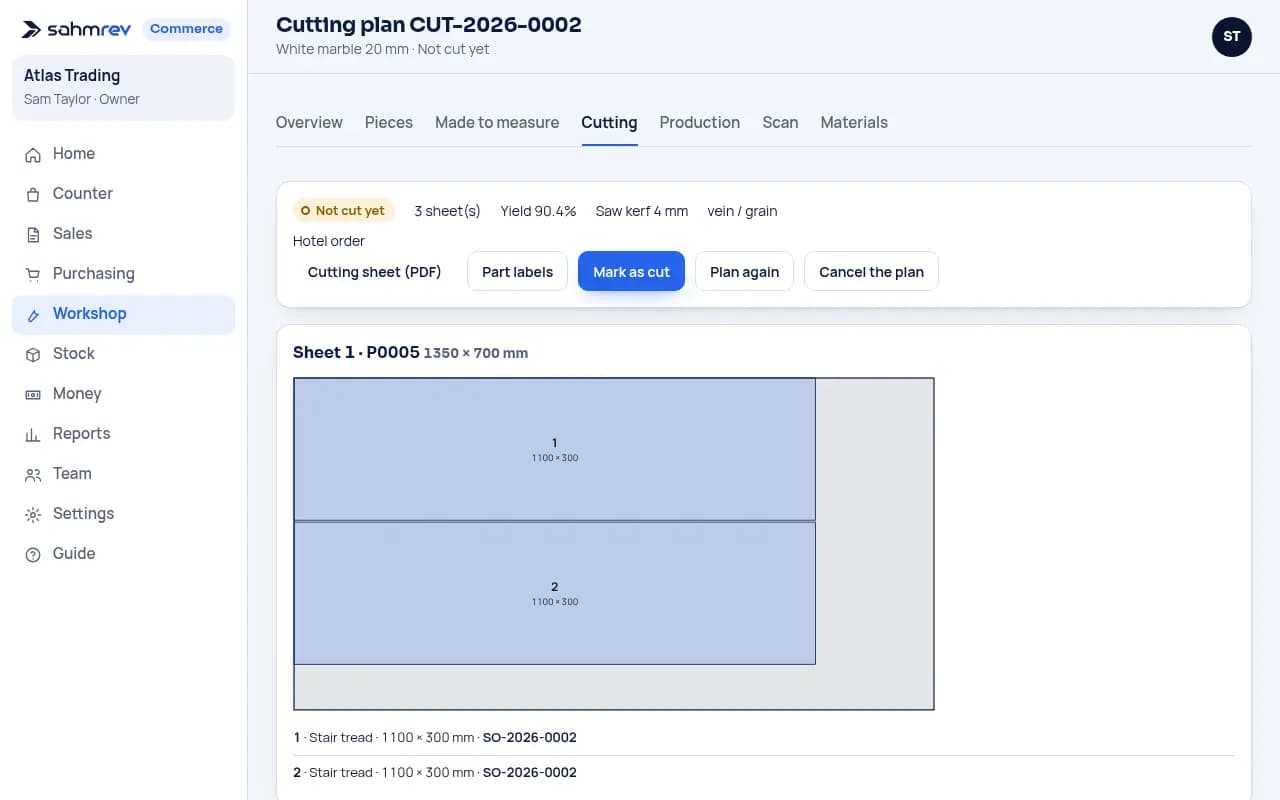
Take one slab read that way: white marble, 20 mm thick, 2760 × 1580 mm. The order asks for ten stair treads of 1100 × 300 mm. The saw blade takes 4 mm with every cut, so the plan counts it between every two parts. Placed two across and five down, the treads take 1100 + 4 + 1100 = 2204 mm of the length, plus one more cut of 4 mm. Across the width they take 5 × 300 mm with four cuts between them, 1516 mm.
What remains is a strip of 552 × 1580 mm along one side. A window sill, a shelf or a small vanity top can come out of it, which makes it one of the usable offcuts worth keeping. It goes back to stock as a numbered piece of its own, with its real size and a label that says which slab it came from. The 64 mm left at the end of the width is too narrow to keep. It is the only real waste of this slab.
Nine cuts on a slab turn 36 mm of stone into dust. A plan that forgets the kerf places the last tread 36 mm short of where it should be. The error is found at the saw, when the slab is already cut. With the kerf counted in every plan, the saw follows the plan as it is, and the saw operator stops correcting it by eye.

Offcuts first, then full slabs
The next order shows why the offcut was worth labelling. Before it opens a new slab, the plan looks at the offcuts in stock, and places the parts that fit there first. Two window sills of 1500 × 200 mm, for example, fit side by side on the 552 mm strip with a cut between them. Only the parts that do not fit on an offcut go to a full slab. Over a month, the offcuts stop piling up against the wall. The plan finds them, so nobody has to remember them.
Marble has a vein, and a sheet of glass or a panel of plywood does not. A worktop and its upstand should share the direction of the vein, and a part turned by ninety degrees looks wrong next to its neighbour. For marble the plan keeps every part in the slab’s direction and never turns it, even when turning it would fit one more part.
With so many constraints, there is rarely only one way to place the parts. The plan tries several orders of the parts on the slabs and offcuts available, and keeps the one that uses the least new stone. That is the best of the orders it tried, and a better placement may exist. The plan says what it did: which slabs and offcuts it used, what each part sits on, and what comes back to stock.
From plan to saw to report
At the saw, the plan becomes a sheet. The cutting sheet lists every slab to take, with its QR code, and the parts to cut from it. When the cuts are done, the plan is marked as cut: the slabs leave the stock, and every offcut large enough to keep comes back as a new numbered piece, linked to the slab it came from. The next plan sees it at once.
Measured this way, waste shows up in the workshop report. It lists the material used on each job and what was lost, saw kerf and waste together. A job that used two slabs where one should have done stands out, and you talk it over with the workshop with the figure in hand.
This is how sahmrev Workshop works for marble and stone. It includes everything in sahmrev Commerce, so the quote, the order, the delivery and the invoice use the same slabs and parts. The stone workshop page shows the slabs, the quote to measure and the cutting plan, and the Workshop page lists what the product includes. The live demo has a stone workshop you can open.
Common questions
- Does the plan use the real size of each slab?
- Yes. Each slab is a numbered piece with the size measured when it arrived, so the plan works from the slab in the yard, not from the size on the price list.
- What happens to the offcuts?
- An offcut at least as large as the smallest piece you keep goes back to stock as a numbered piece with its own label, linked to its slab. The next plan uses offcuts before it opens a new slab.
- Does the plan keep the direction of the vein?
- Yes. For marble, parts keep the slab’s direction and are never turned.
- Is the plan always the least material possible?
- It tries several orders and keeps the one that uses the least new stone among them. It is the best of the orders tried, not a proven minimum.